


0 Comment
VO2 Testing: Its helps maximize your exercise benefits!
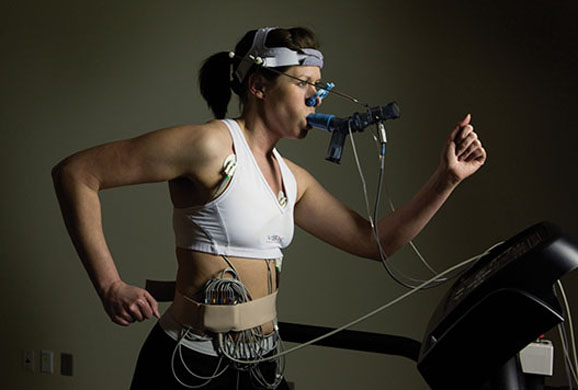
VO2 Max Testing, or measuring your oxygen uptake, is a valuable test in determining both your exercise strategy and your actual heart rate zones based on your metabolism. It is the most essential fitness factor for a longer life.
VO2 Max testing involves using a bike or treadmill as the exercise method. During increasing effort or resistance, you breathe through sophisticated sensors that measure O2 intake, CO2 expelled, heart rate, and other metrics. Tests are relatively short, 9-15 minutes, so anyone can do one as it is only the last 60 seconds that is difficult.
Why get a test?
Estimated heart rate zones are inaccurate for 93% of the population. Maximal heart rate, while showing a decline with age, does not decrease equally for everyone. Additionally, there are differences in heart rate responses between women and men. Women tend to have much higher heart rates during exercise. A good VO2 test will utilize metabolic marker points to establish training zones based on the individual’s response and physiology. Those vary significantly from person to person. In car terms, the speedometer and tachometer should be matched to the specific engine and car. Using the sliding HR scale on many treadmills is less than helpful. It is regularly 25-50 bpm off from what the person should be doing in terms of intensity. No wonder people exercise and get less than expected results.
A focus of this test should be determining your Anaerobic Threshold (AT). Your AT generally occurs when your CO2 output is slightly greater than your O2 intake, indicating that you are starting to overexert your body, or sprint. Determining your AT is essential for many reasons.
For weight loss, it’s crucial because an ideal weight loss cardio program occurs at a level of intensity below this threshold. The goal is to exercise for the maximum number of minutes at an exercise level where fat is a significant fuel source. If a person can elevate their AT, they can maintain a faster pace in cardio exercise and lose more weight. Additionally, below AT is where you can engage in meaningful exercise while recovering from something like a cycling class or weight training. Having a recovery zone boosts performance for the next difficult workout while keeping you exercising.
Weight training? Your AT is important, as a higher level means you can work harder with shorter rest periods. More AT, you can work at a faster pace. Imagine you could only perform 28 sets of exercise in a resistance session. Not bad. However, elevate your AT, and now, in the same session, you can complete 47 sets of exercise. Big difference in results based upon volume! Partially because ability is improved, and also because you can tolerate that intense burn in the muscles without having to stop.
Training AT is explicitly more than time-efficient; it has the best results. If you are going to use interval training, like a Spinning class, precisely knowing these zones above AT is very useful for interval training to get maximum results. You know how hard it is to sprint, and where to recover between sprints. Sports like basketball will build some elevated AT, not quite as good as structured interval training.
What is the endpoint in a VO2 max test?
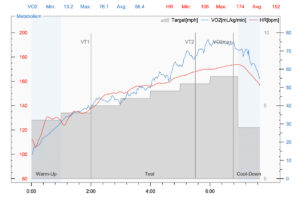
A sample CO2 versus O2 comparison in a maximal test.
The test is considered maximal when your CO2 output is at least 10% higher than your O2 intake.
Part of determining whether the test protocol is sub-maximal or maximal involves the equipment, and part is the test technician. Ensure that the testing equipment you use yields the most accurate results. There is a significant difference between sub-maximal tests (equipment like NewLeaf, Korr, iMett, etc.) and medically based equipment (Vmax Encore, Vyaire, Cosmed, Oxycon Mobile, MedGraphics, Cortex, etc.). Sub-maximal testing takes you right to that transition point, and then tries to predict your maximal values from that point.
Numerous research studies show that sub-maximal testing overestimates your fitness levels by 25-50%. Since maximum effort can have a wide range of heart rates, it is likely to give you inaccurate upper heart rate zones. The result is that you will likely struggle to focus your training because there is no VO2 max to AT ratio, and you will not have actual heart rate data for your upper training zones. Therefore, you won’t know how much time to allocate to steady-state versus interval training, and your heart rate zones will be projected, rather than individually accurate.
Less expensive equipment lacks the sensing sophistication to accurately define all these essential parameters/metrics. Choose an exercise physiologist who has performed a large number of tests, as their ability to apply the information to you is much better!
The message is that if you are serious about your exercise program, get a VO2 Max test. If you do, make sure it is a maximal test; otherwise, do not bother.
They are going to cost about the same, $225-$325, but the application to your fitness is radically better with the VO2 Max test.
And remember, this is more important for you as a recreational exerciser than for professional athletes.


